
Kansas Teen Graduated Licensing Guide History Benefits and DMV Permit Requirements
A teen driver’s first license should not feel like being handed every driving risk at once. Kansas uses a graduated driver licensing system to add driving privileges in stages, so new drivers gain experience before facing harder conditions like nighttime traffic, peer passengers, and fully independent driving.
Kansas does not officially call its licensing agency the DMV. It is the Kansas Department of Revenue, Division of Vehicles. Still, many families search for “Kansas DMV” when they need permit and license rules. The most useful official starting point is the State of Kansas page for the Kansas Graduated Driver License. For identity documents, Kansas also maintains a page for driver’s license proof of identity and residency requirements.
This guide summarizes how the Kansas teen graduated licensing program works, why graduated licensing exists, what benefits it offers, and what documents teens usually need for permits and licenses. Rules can change, so use this as a plain-language overview and confirm details with the Kansas Division of Vehicles before applying.

Kansas teen licensing works in stages
Kansas uses graduated driver licensing, often shortened to GDL, for young drivers. The basic idea is simple: a teen does not move from no driving experience to full driving freedom in one step. Instead, Kansas separates the process into permit, restricted driving, and full licensure.
The exact path can vary based on age, driver education, supervised driving hours, and driving record. Kansas also has a farm permit option for eligible teens connected to farm work, but most teen drivers follow the standard permit and restricted license path.
Here is the general structure.
Kansas licensing stage | Typical minimum age | What it allows |
Instruction permit | 14 | Practice driving with a licensed adult in the front seat |
Restricted license | 15 | Limited independent driving after meeting permit, education, and practice requirements |
Expanded restricted privileges | 16 | More independent driving, still with limits on time of day and passengers |
Nonrestricted license | 17 | Full driving privileges, if requirements are met |
Kansas sets limits because the highest-risk period for many drivers is the first period of independent driving. A permit stage lets a teen practice while an experienced adult is present. A restricted stage limits the situations most likely to overwhelm a new driver.
The Kansas instruction permit
The instruction permit is the first step for most Kansas teen drivers. A teen can generally apply at age 14.
With an instruction permit, the teen must drive with a licensed adult who meets Kansas requirements. The supervising adult must sit in the front passenger seat. The permit is meant for practice, not independent driving.
Kansas generally requires the teen to pass a vision screening and written knowledge test, unless a qualifying driver education document applies. The teen must also provide identity and residency documentation, and a parent or guardian is usually involved for a minor applicant.
The Kansas restricted license
A restricted license gives a teen some independent driving privileges, but with limits.
A 15-year-old applicant generally needs to complete approved driver education, hold an instruction permit for the required period, and document supervised driving practice. Kansas commonly requires at least 25 hours of adult-supervised driving before this stage.
Restrictions for younger drivers focus on where and why the teen may drive. For example, Kansas rules commonly allow driving to and from school, work, or certain approved activities, along with driving while accompanied by a qualified adult. Passenger and wireless device restrictions may also apply.
Expanded privileges at age 16
At age 16, Kansas may allow broader driving privileges if the teen has met the practice requirements. This usually includes a larger supervised driving total, commonly 50 hours, with some nighttime driving practice included.
Even then, Kansas still places limits on teen drivers. These may include limits on nighttime driving, nonfamily teen passengers, and wireless communication devices. A moving violation or crash-related issue can delay progress through the system.
Nonrestricted license
A Kansas teen can generally qualify for a nonrestricted license at age 17 after meeting the state’s requirements. By that point, the teen should have experience with supervised driving, limited independent driving, and a wider range of normal road conditions.
That is the point of the program. Full licensure comes after practice, not before it.
Graduated licensing programs grew from a safety problem
Graduated licensing did not appear by accident. It developed because crash data showed a consistent problem: new teen drivers face higher crash risk than more experienced drivers.
The issue is not that teens cannot become good drivers. Many do. The issue is that driving requires judgment built through repetition. New drivers have to learn how to scan intersections, read other drivers, manage speed, handle distractions, and respond to bad weather. Those skills take time.
Night driving adds another layer. So do passengers. A car full of friends can change the way a new driver behaves, even when no one means to create risk.
The modern graduated licensing model is often traced to New Zealand, which adopted an early version in the 1980s. During the 1990s, states in the U.S. began adopting similar systems. Florida is widely recognized as one of the first U.S. states to adopt a comprehensive graduated driver licensing law in the mid-1990s. Over time, every state created some form of GDL, though the rules differ.
The strongest programs tend to share several features:
A learner period that lasts long enough for real practice
Required supervised driving hours
Nighttime driving limits
Passenger limits for young drivers
Restrictions on phone use
Penalties or delays for violations
Kansas follows this same general pattern. It does not remove all risk, but it reduces the chance that a brand-new driver will face the most difficult driving situations too soon.

The benefits are practical and proven by experience
Graduated driver licensing works because it matches driving privileges to driving experience. It gives teens room to learn while reducing exposure to the riskiest conditions.
Public safety groups, insurance researchers, and state highway agencies have long supported GDL systems because they are linked with fewer crashes among the youngest drivers. The clearest benefits tend to appear among 16-year-old drivers, who otherwise would be in the earliest and riskiest stage of independent driving.
Teens get more supervised practice
Practice matters most when it is varied. A teen who only drives the same short route on sunny afternoons may not be ready for rain, highway merging, school traffic, gravel roads, or dusk.
Kansas supervised driving requirements push families to build practice time before independence. The 25-hour and 50-hour milestones give structure to that practice. The nighttime requirement also helps because driving after dark changes depth perception, glare, visibility, and reaction time.
Families get a clearer roadmap
Without a GDL system, families may not know when a teen is ready for the next step. Kansas gives families a sequence.
Get the permit. Practice with an adult. Complete driver education when required. Record hours. Move to restricted driving. Earn broader privileges. Then qualify for a nonrestricted license.
That structure makes the process easier to manage. It also gives parents and guardians a reason to say no to risky driving situations while the teen is still learning.
Passenger and nighttime limits reduce common risks
Two common risks for new drivers are late-night driving and transporting other teens. Both situations can increase distraction and pressure.
Kansas restrictions are designed to limit those risks. A teen may feel ready to drive anywhere at any hour, but the licensing system slows that transition. The goal is not punishment. The goal is building judgment under safer conditions.
Good habits start earlier
Kansas also restricts wireless communication for teen drivers. That matters because distracted driving habits can form early.
A teen who learns from the beginning that the phone stays away while driving is more likely to treat that as normal. GDL systems can set expectations before bad habits become routine.
Kansas permit and license documentation usually falls into a few categories
Kansas documentation rules can feel confusing because there are two overlapping issues. The first is proving eligibility for a permit or license. The second is proving identity and residency under Kansas and federal REAL ID standards.
The official Kansas proof page is the best source to check before visiting a licensing office: Kansas driver’s license proof requirements.
Most teen applicants should be ready to show documents in these categories.
Document category | Common examples | Why Kansas asks for it |
Proof of identity and lawful presence | Certified birth certificate, valid U.S. passport, permanent resident card, other approved immigration document | Confirms who the applicant is and legal eligibility |
Social Security number proof | Social Security card, W-2, 1099, pay stub with required information | Confirms the applicant’s Social Security number |
Proof of Kansas residency | Mail, statements, school records, or other approved documents showing a Kansas residential address | Confirms Kansas residence |
Parent or guardian involvement | Parent or guardian signature or consent when required | Required because the applicant is a minor |
Driver education document | Approved driver education completion certificate when used or required | Shows the teen completed approved training |
Driving practice affidavit or log | Supervised driving certification showing required hours | Shows the teen completed required practice |
Current permit or license | Existing Kansas instruction permit or restricted license | Shows the teen’s current licensing stage |
Do not rely on photocopies unless Kansas says they are acceptable. Many identity documents must be originals or certified copies. Names should also match across documents. If a teen’s name has changed, Kansas may require legal proof of the name change.
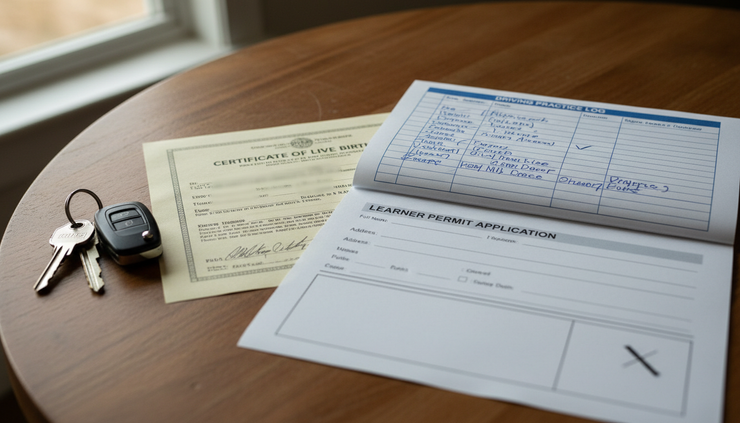
What teens need for each Kansas licensing step
The safest way to prepare is to build a folder for each stage. The folder should include identity documents, Kansas address documents, any driver education paperwork, and driving hour records.
For a Kansas instruction permit
A teen applying for an instruction permit should generally bring:
Proof of identity and lawful presence A certified birth certificate or valid passport is commonly used.
Proof of Social Security number A Social Security card is the simplest example, but Kansas lists other acceptable documents.
Proof of Kansas residency Check the Kansas proof page for accepted documents, especially if the teen does not receive bills or official mail.
Parent or guardian consent A parent or guardian should expect to participate when the applicant is a minor.
Testing or driver education paperwork The teen may need to pass the written knowledge test and vision screening, or provide approved driver education documentation if applicable.
For a Kansas restricted license
A teen seeking a restricted license should generally bring:
Current Kansas instruction permit Kansas will need to confirm the teen has held the permit for the required time.
Approved driver education completion document This is especially important for 15-year-old applicants.
Supervised driving record Kansas commonly requires proof of at least 25 hours of supervised driving for this stage.
Identity and residency documents Bring them if Kansas has not already verified them or if the applicant is upgrading to a REAL ID credential.
Parent or guardian involvement A minor applicant should not assume they can complete the process alone.
For expanded privileges or a nonrestricted license
For the next stage, the teen should be ready with:
Current restricted license This shows the teen’s current status.
Supervised driving affidavit Kansas commonly requires 50 total hours, including nighttime practice, before full or broader privileges.
Clean driving record expectations Traffic convictions or violations can delay progress.
Updated documents if needed If an address changed or a REAL ID upgrade is involved, Kansas may ask for updated proof.
The Kansas Division of Vehicles also provides forms and licensing information through its main site. The graduated licensing page is the best place to begin: Kansas Graduated Driver License.
A simple way to prepare before visiting the licensing office
A little preparation can save a second trip. Before going to a Kansas driver’s license office, do three things.
First, check the teen’s age and current stage. A 14-year-old permit applicant, a 15-year-old restricted license applicant, and a 17-year-old full license applicant do not need the same paperwork.
Next, compare the documents in the folder with the Kansas proof list. Use the official Kansas proof of identity page, not a third-party checklist that may be outdated.
Then, review the driving record and practice hours. If the teen needs 25 or 50 hours, make sure the log or affidavit is complete before the visit. If nighttime hours are required, separate them clearly.
It also helps to check testing requirements. A teen may need a vision screening, written test, driving test, or driver education completion certificate depending on the licensing stage and circumstances.

The main takeaway for Kansas families
Kansas teen licensing is built around a clear safety idea: new drivers need time, structure, and limits before full independence. The permit stage builds basic skill. The restricted stage adds limited solo driving. Later stages expand privileges after more practice.
The process works best when the paperwork is treated as seriously as the driving practice. Keep identity documents, residency proof, driver education records, and supervised driving logs together. Check the official Kansas pages before each step, especially the Kansas Graduated Driver License page and the Kansas proof requirements page.
A license is more than permission to drive. For a teen, it is a gradual transfer of responsibility. Kansas graduated licensing makes that transfer safer, more measured, and easier to understand.


Comments